What Did Arts and Literature Learn in Middle Passage
Teach shut reading skills, slave narratives, and catholic retribution with J.M.Westward. Turner's The Slave Send
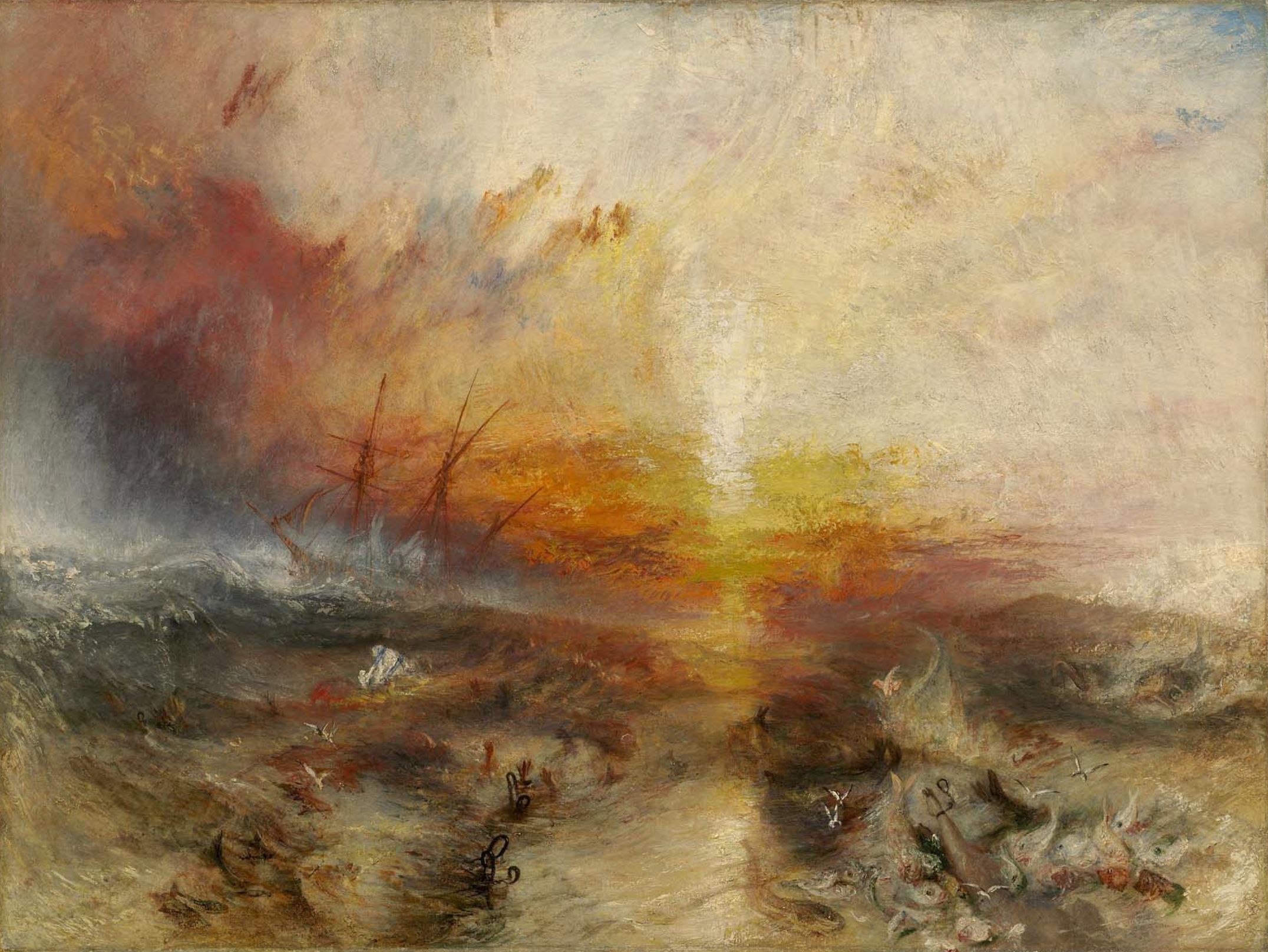
J.M.West. Turner's The Slave Ship is in the collection of the Museum of Fine Arts, Boston. See their website for more detailed information. Click on the painting for a high quality image.
On 6 September 1781, the Zong, a slave ship, left…the due west coast of Africa, bound for Jamaica. The ship was cruelly overcrowded, carrying 442 Africans…The human cargo was manacled and packed so tightly, they had no room to move. But for the captain, Luke Collingwood, the more Africans he could squeeze in, the greater the margin of profit for both the send'due south owners and himself.
Simply by mid-November, the inexperienced Collingwood institute himself in the mid-Atlantic, unable to navigate out of the calm winds of the Doldrums. The slaves, suffering from malnutrition, dysentery, scurvy and disease, began to die. By 28 Nov, 60 had died, along with seven crew members. Many more were falling sick. Collingwood began to panic—the commitment of dead slaves would earn the send owners aught. If, nonetheless, the Africans were somehow lost at sea, then the ship owners' insurance would cover the loss at £30 per caput.
And so Collingwood…made an unimaginably cruel, only to his mind, logical conclusion. Rather than allow the ill slaves to die on lath and be rendered worthless, he would throw them overboard—and hence claim the insurance. …Thus, on 29 November, 54 sick slaves, mainly women and children, were dragged from below deck, …and heaved from the send into the ocean. The post-obit day, more were murdered. In the end, Collingwood had thrown 133 slaves to their deaths. Many struggled and the coiffure had to tie iron balls to their ankles. Some other ten slaves threw themselves overboard in what Collingwood described as an act of defiance.
—The Zong Massacre,which inspired J.Chiliad.W. Turner's The Slave Transport, came to lite when an insurance company, citing insurance fraud, refused to encompass the losses of "cargo." The resulting court cases (Gregson v. Gilbert) brought the depravity of the slave trade to the public consciousness and spurred on the abolition movement in Britain.
Look at The Slave Ship. Before reading the excerpt higher up, tell students the championship of the piece and ask what is going on in this picture show? Some early critics found this painting hard to understand so students may as well. See how much they can decipher through a group discussion. Encourage students to place the evidence that supports their reasoning. Students should likewise be encouraged to share wonderings and vocalisation confusions. As the conversation slows, explicate you are going to read an account of the Zong Massacre, the result that inspired the painting. After reading the extract inquire how does this new insight change your understanding of the painting? What additional things do you see at present?
Begin with art history
Joseph Mallord William Turner is unremarkably referred to every bit "the painter of light" and is recognized past many as the greatest British painter of the 19th century. Every bit a child, Turner was a precocious artist selling pictures in the window of his father'due south barber/wig shop at the age of 11. By the age of 13 he worked for several architects and studied under the topographical draftsman Thomas Malton. These architectural studies and exercises in perspective informed his work throughout his career. He entered the Majestic University of Art in 1789 at the age of 14.
His architectural focus soon included nature's majestic architecture. This ran counter to the art establishment that shunned landscape painting every bit a lowly art form akin to still-life painting. Rather, they held that the thousand tradition of history painting was the noblest fine art form since information technology depicted the heights of human virtue. Turner contended that landscape painting could be equal in complexity and expressive potential to history painting and strove to depict the sublime and awesome ability of nature. His initial arcadian landscapes eventually became magnificent renderings of atmospherics and light. His storms contained moral outrage and his sunshine expressed a cosmic caress.
In The Slave Ship Turner depicts a draft powered by cosmic reckoning and divine retribution every bit it bears down on the slave ship Zong. The atrocities of the Zong massacre (described in a higher place) had galvanized the abolitionist movement in England and contributed to the abolition of slavery in Britain in 1833. Now Turner and other abolitionists wanted to use the strategic exhibition of The Slave Ship (1840) during an anti-slavery conference to reenergize the abolitionist movement and spread British anti-slavery efforts. In The Slave Ship Turner created a history painting that wedded the Romantic'due south focus on the sublime with real world events and political motivations. While Turner continued to paint for another 11 years, many consider this his greatest painting.
Turner's piece of work is historic for taking Romanticism to new heights. It is also recognized for setting the stage for art movements to come up. His focus on depicting calorie-free and dissolving forms into atmospheric colors links him to Monet and the Impressionists. The way he reveled in the physicality of his medium and his thick awarding of the pigment with a pallet knife and his fingers to elicit an emotional response ties his work to modernist painting. During a Turner retrospective in 1966, Marker Rothko joked, 'This guy Turner, he learnt a lot from me."
Look like an art critic
This paradigm of The Slave Ship from the Museum of Fine Arts, Boston offers more item and groundwork data.
Color
Point out and hash out: "The sunday is God" were the final words Turner uttered from his deathbed and they express his increasing fixation on natural lite in his paintings. The expressive potential of this calorie-free is manifested through Turner's employ of color. What practice the colors in The Slave Ship remind y'all of and how does Turner's use of color serve the artist'due south intentions?
Plow, Talk, and Report Dorsum (Possible answers: The bright reds, oranges, and yellows that shroud the slave ship create a sense of drama and fury. The body of water and atmosphere effectually the slave transport seems to erupt with violence and chaos. The yellow and white of the dominicus'due south light swirls up like a flame that threatens to both illuminate the atrocity and purge the evil. The ship sails into the darkest parts of the painting. The dark purples and blues blend the heaven and ocean creating an overwhelming atmosphere of danger and foreboding. The gratis colors, dejection and oranges and purples and yellows intensify each other heightening the visual and emotional response. The top correct corner and the bottom left corner are the lightest points of the composition and, in contrast, create a diagonal of saturated colors that connect the slave ship with the drowning slaves. The murky density of the ocean in the foreground full of partially identifiable body of water creatures enhances the sense of anxiety and uncertainty. The immensity of the atmospheric coloring makes the small human elements seem even more frail. The colors and their strategic placement focus the violence of the tempest on the slave ship equally if it were some kind of cosmic reckoning.)
Line
Bespeak out and discuss: As an element of art, line is the use of outlines, implied lines, and patterns of marks to create an identifiable path in an artwork. They are often used to atomic number 82 the viewer's optics around the limerick, organize significant elements, and communicate information. The use of diffused light in Turner's landscapes ofttimes softened the landscape to brainchild and disintegrated class and line. What lines practise you see in The Slave Ship and how does Turner's use of line or the lack of line serve his intentions?
Turn, Talk, and Written report Dorsum (Possible answers: Most of the painting is a blur of colors so the few elements shown with singled-out lines take on added significance. The ship's masts are rendered with hard slashing diagonal lines, underscoring the ship'due south instability and the fury of the storm. The ship's lines go less distinct every bit they about the water as if the ocean was devouring the ship. The other distinct lines are the drowning slaves shown in the foreground. The most distinct is the shackled leg that points back across the composition to the ship. The distinct lines of the leg likewise concenter the viewer'due south attention to the bondage and the open, despairing hands that rise up out of the water. Together, these elements point accusingly at the send and visually anchor the fleeing ship to the drowning slaves. The blurred brush strokes and indistinct lines of the waves in the foreground draw the sea as roiling with the free energy of the storm and the feeding frenzy of the bounding main creatures devouring the slaves. The murkiness and lack of identifiable markers depict on the viewer'southward imagination and brand the unknown that much more than unsettling. The lack of a singled-out horizon line makes the ocean and the sky writhe together in an all-enveloping, violent, swirling motion. This turbulent vertical movement suggests a cosmic retribution is raining downwards on the delicate ship and its loathsome crew.)
Title and Text
Point out and discuss: The Slave Transport was originally titled Slavers Throwing Overboard the Dead and Dying—Typhon Coming On. In addition, Turner exhibited the painting with an extract from his unfinished poem Fallacies of Promise (1812),
Aloft all hands, strike the top-masts and belay;
Yon aroused setting sun and fierce-edged clouds
Declare the Typhon's coming.
Before information technology sweeps your decks, throw overboard
The dead and dying – ne'er heed their chains
Hope, Promise, fallacious Hope!
Where is thy marketplace at present?
How does the original title and the verse form impact your reading of The Slave Ship? How does Turner'due south use of text support his visual efforts?
Plough, Talk, and Study Back (Possible answers: The longer title gives additional context for the scene. This title underscores that the dying slaves in the water had been thrown overboard by the departing ship and that the ship is existence chased downwardly by a typhoon. The structure of the longer championship suggests a causal relationship between the actions of the slavers with the oncoming storm, farther reinforcing the sense of cosmic retribution. The poem too adds context and helps the viewer recognize of import details. The verse form's final two lines give added emphasis to the despair depicted in the painting. The final line highlights Turner's abolitionist leanings and reminds the reader that this calculated depravity is driven by a sordid market for slaves.)
Recall like an artist
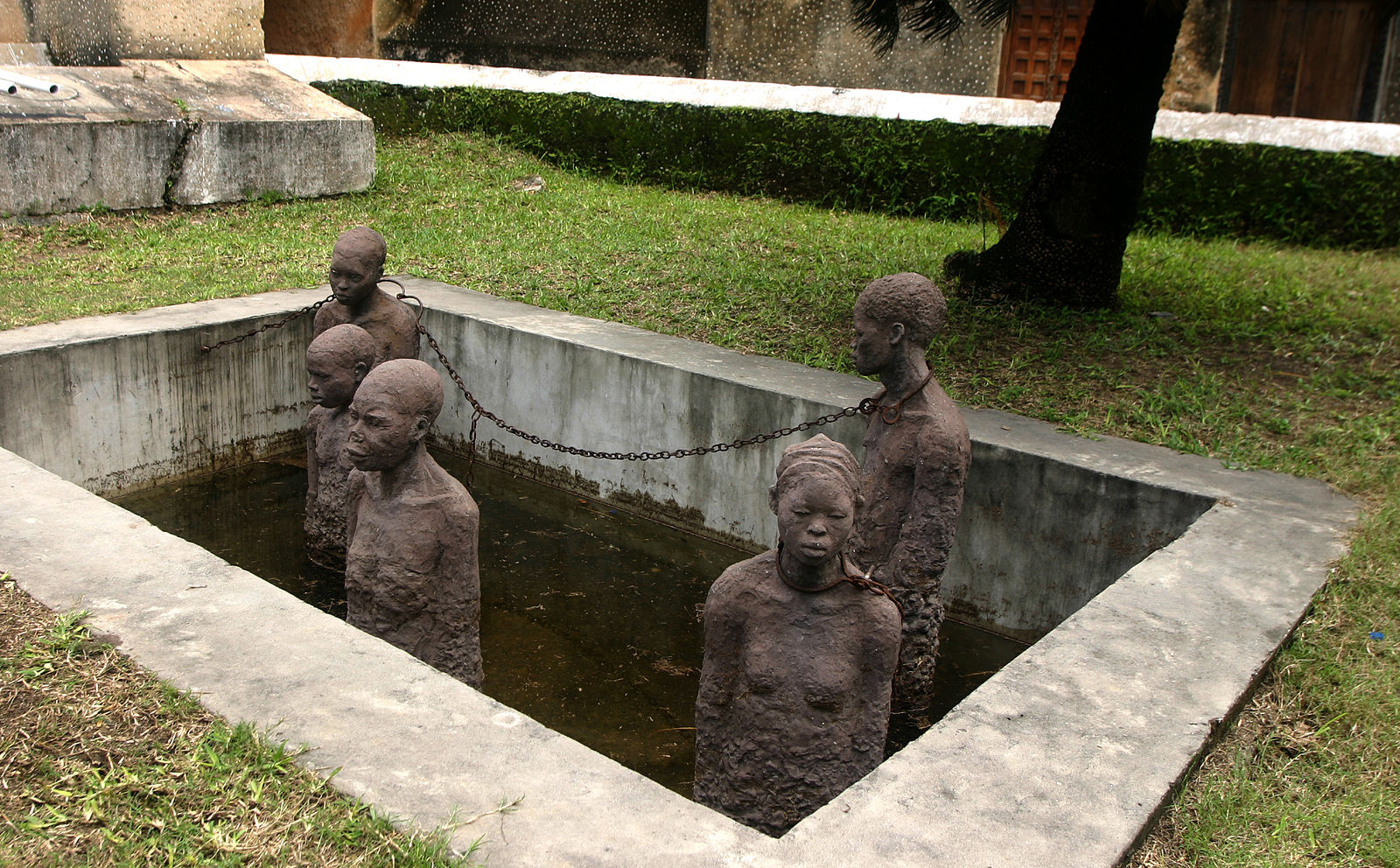
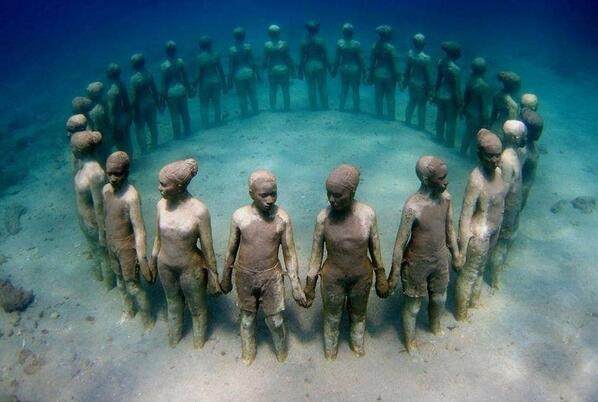
Like Turner, other artists accept used their art to phone call attention to the horrors of the Middle Passage and the cruelty of the slave merchandise.
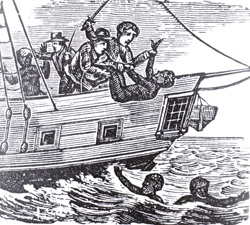
- This unattributed etching is oftentimes used to illustrate the Zong massacre
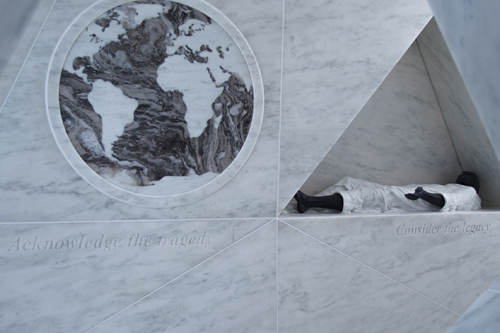
- The Ark of Return by architect Rodney Leon is a permanent memorial to honor the victims of slavery and the transatlantic slave trade at the United Nations.
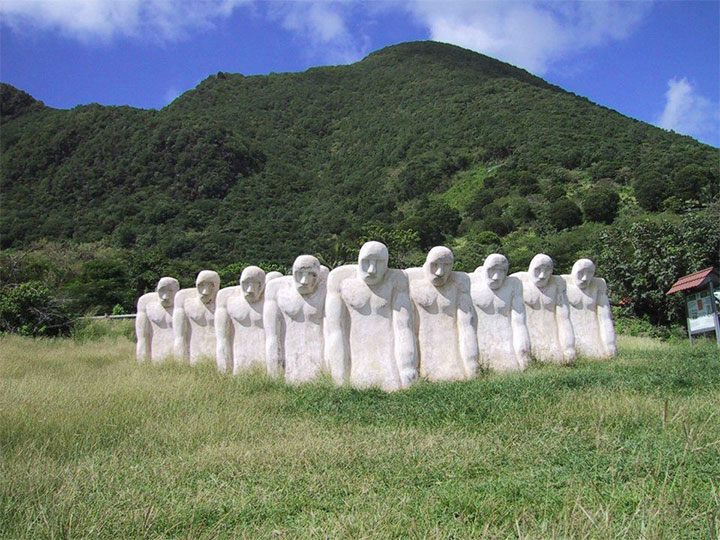
- Memory Cap 110 and Fraternity past Laurent Valere commemorates the slaves who died when their captive send ran aground on the rocks of Anse Caffard in southern Martinique.
- Memory for the Slaves by stone sculptor Clara Sörnäs recognizes the office Zanzibar played as a transit port for African slaves going to Mauretania and the Standard arabic countries.
- Viccisitudes by underwater installation artist Jason DeCaires Taylor has go a much-heralded memorial to drowned African slaves, even though the artist never intended information technology to be. This is a great case study for exploring artist intentions and audition interpretations.
- For additional memorials almost slavery, serfdom, and emancipation visit this site.
Compare how this art evokes the atrocities of the Middle Passage with Turner'due south The Slave Send. Practice they share any imagery? Practise you think 1 of these pieces is more effective at raising public consciousness? What elements in the artwork make it specially effective for you? How would your comparison of these artworks inform a piece of fine art y'all might make to heighten public sensation well-nigh a social injustice?
Life Lesson
Integrate reading, writing, and art making.The abolitionist Thomas Clarkson recognized that art and artifacts were able to influence public stance more than mere words solitary and then he nerveless chests of African crafts and goods to accompany his anti-slavery lectures. Clarkson went on to write The History of Abolition of the African Slave-Merchandise. This book inspired Turner to paint The Slave Transport. Equally noted above, Turner likewise exhibited his painting with poetry. Reading, writing, and fine art making creatively and intellectually intertwine. Artists and life's problem solvers use a good for you dose of all 3 to fully engage their minds.
Related videos
- Simon Schama's J.M.W. Turner 4 of 4 (14:31) describes Turner's last works, including The Slave Send, and his influence. Preview this with your students in heed every bit the drowning of the slaves is quite graphic and agonizing. To create a context for office 4, you may want to view with the preceding Simon Schama'southward J.Yard.W. Turner 3 of 4 (fourteen:58).
- Turner, Slave Ship (Slavers Throwing Overboard the Expressionless and Dying, Draft Coming On), 1840 (four:01) analyzes fundamental elements of the painting.
- The Dandy Artists—The English Masters—Turner (49:26) offers a comprehensive overview of Turner'due south life and work.
Integrating into Your Curriculum
Artists oftentimes use common visual strategies or signposts to warning viewers to significant details in their art. Here are some ideas for using these visual signposts to unpack a work of art. Think, the close reading skills in art appreciation are like to the close reading practices taught in reading.
Fine art-based Research Study: J.M.W. Turner'due south The Slave Transport sets the phase for an art-based research study that uses slave narratives and ekphrastic poetry to give vocalization to the Zong massacre and the horrors of the slave trade'southward Center Passage.
Literature Links: What piece of literature would y'all partner with The Slave Send?
The Slave Send could inform the study of slave narratives or abolitionist literature such as:
- Olaudah Equiano's The Interesting Narrative of the Life of Olaudah Equiano, Written by Himself
- Harriet Ann Jacob'due south Incidents in the Life of a Slave Girl
- Frederick Douglass' Narrative of the Life of Frederick Douglass, an American Slave
- Harriet Beecher Stowe'southward Uncle Tom's Cabin
- This site is rich with excerpts from slaves narratives, including the Middle Passage
The Slave Ship could inform the study of Romantic poetry such as:
- William Wordworth'southward Lines Composed a Few Miles above Tintern Abbey
- Samuel Taylor Coleridge'southward The Rime of the Ancient Mariner
- Walt Whitman's Song of Myself
Writing opportunity: Comparison essay. J.M.W. Turner and Pablo Picasso both used their characteristic visual vocabulary to reply to social injustices that plagued their world. Turner's The Slave Transport highlighted the atrocities of the slave trade. Picasso's Guernica highlighted the atrocities of mod warfare. Both artists depicted a specific event to highlight universal issues. Have students write a comparison essay that analyzes these ii paintings.
How would you use this painting to elaborate on ane of your units of study? Delight share if yous have other ideas on how to teach The Slave Send by J.M.W. Turner as an English language/linguistic communication arts lesson plan.
Source: https://charlesmcquillen.com/joseph-mallord-william-turner-the-slave-ship-english-language-arts-lesson-plan/
0 Response to "What Did Arts and Literature Learn in Middle Passage"
Post a Comment